reciprocity of place
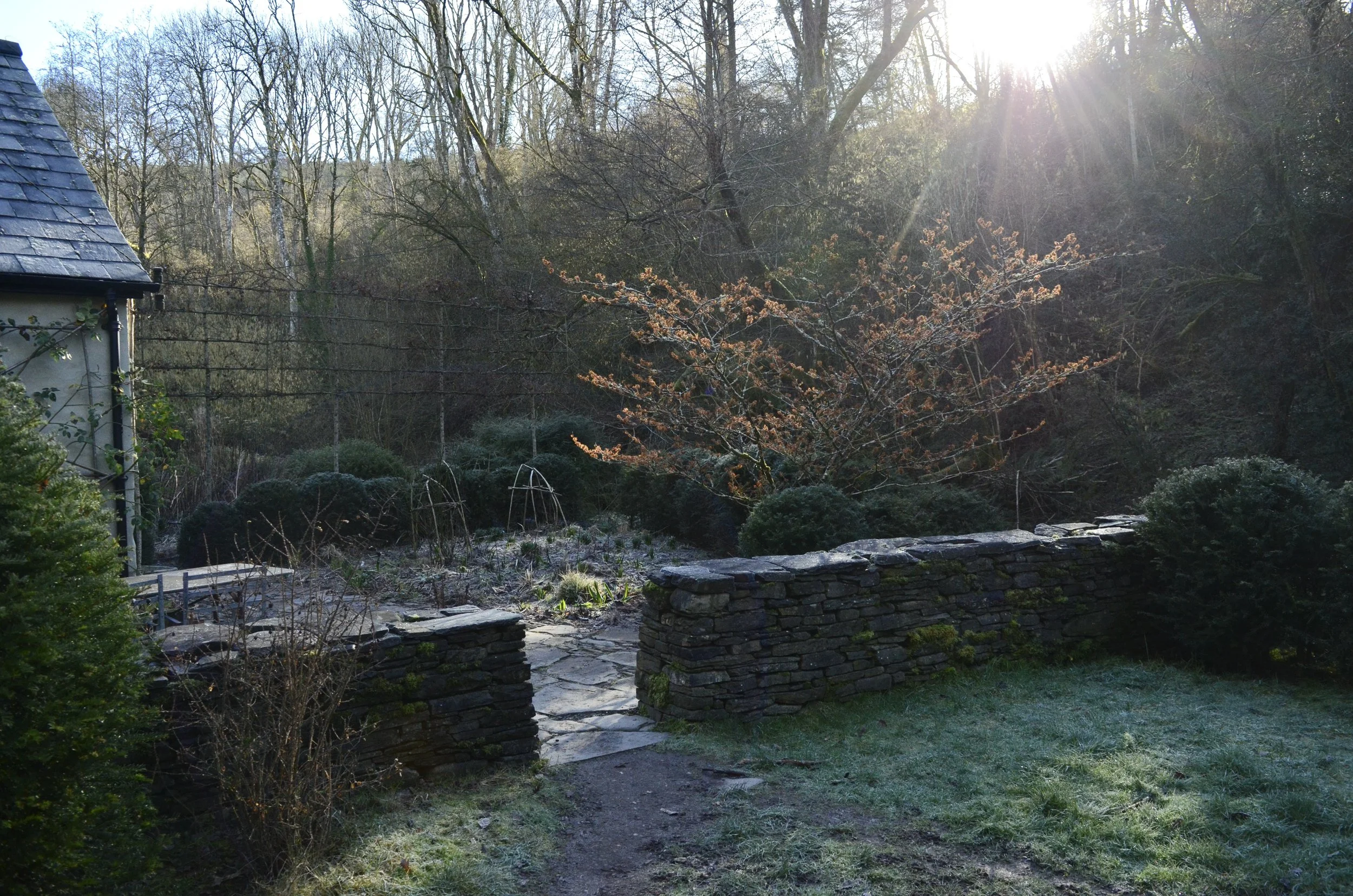
The sun stretches through the bare stems of the Ash, the filtered light fragmented as it passes each trunk atilt with wayward reach, a moment of warmth now cusps in the garden, sparing at best, but enough to ignite the fiery tassels of the Hamamelis that sits with poise within the confines of the Taxus hedge. Of recent, Dave and I wandered closely to the Hamamelis; its position near the seating space allows for this interaction, and every so often we like to embrace its honeyed and spiced aroma, quite an unexpected interaction, especially in the cold clarity of Winter, and I must admit that since early December it has provided a rooting radiance whilst all else sat entangled, bleached, blackened, and beguiled.
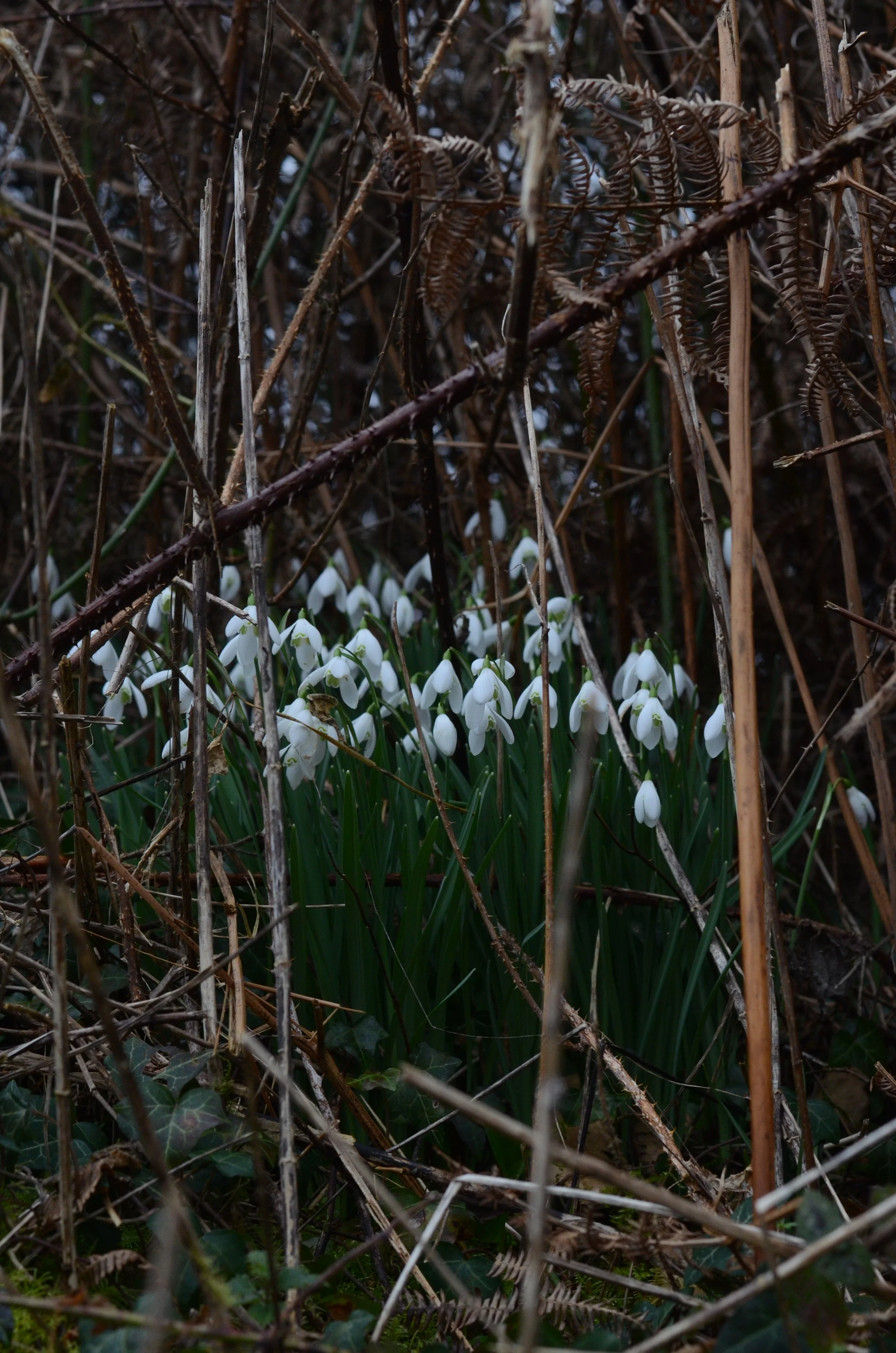
During November we pushed forwards with our bulb planting, wanting to establish another layer of interest here at Ty Gardd, but since then the garden has hung in anticipation for the first snowdrops to appear, their pure white pendulous flower heads lifting the darker corners with illuminating clarity. Of recent, I have become obsessed, rubbernecking on my drives too and from the house, eyes peeled for this white jewel that most often hunkers beneath the dormancy of the native hedgerows, enjoying the warm light before Spring greens engulf its settled self. I recently drove past a house where snowdrops had blanketed the front slopes and lawn of the garden with a boldness that told of time; I too have this resoluteness to establish my own fleeting white carpet.
It's only now and again that I get reminded that over the years I have slowly covered all walls of my house with plants, no obvious space left to reveal the limewashed façade, which now sits patinated and aged with subtle mottling. This February we took a clear day with scattered showers to commence on the technicalities of stripping the garden back to its bones, pruning the Wisteria back to 2/3 buds from the main framework, made more interesting by my missed Summer prune last year, that I have promised myself I will not forget again. These pruning jobs are simple work, but nonetheless work that allows the gardener to bestow order and abundance onto the unruly nature of climbers. I have decided to keep the Wisteria natural, the hazel framework, which now shows signs of softening, has allowed a delicate yet harmonious structure for the Wisteria to conquer, although its wandering arms almost always find their way into the eaves and now reaching for the slates. I have seen Wisteria grown in more strict, sculptural formworks, but I tend to prefer a more loosely strung presentation, to allow informality and a sense of wandering nature to soften the façade of the house, and I have found, over the years, that it embraces the framework of the pleached trees, its stems tight and coiling with intent to conquer the strict formality of the architectural presence that divides the garden. I have let this embrace occur, but with sensitivity, allowing them to mingle as friends, each Winter reducing its overbearing personality back to a warm embrace. Once the Malus ‘Evereste’ have finished flowering, the Wisteria continues the meeting of these two painterly species.
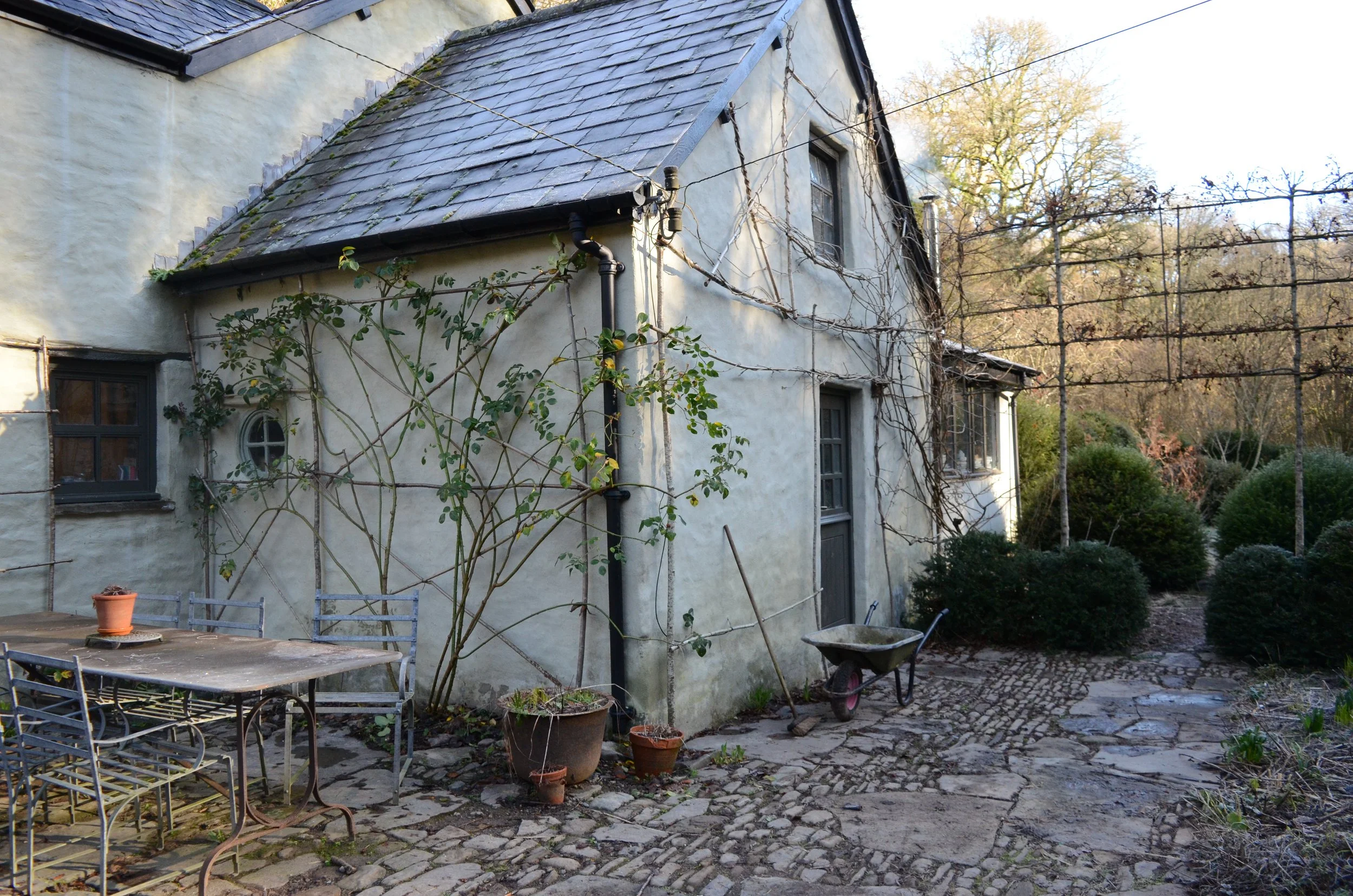
The rose, on the contrary, sits slightly more hidden from the early sun on the West-facing wall; again, hazel supports outline a decorative framework, horizontal and diagonal stems set the rose off the wall, allowing both airflow and ornamentation; subtle, more in tune with the surrounding woodland, a more pared-back aesthetic than that of wire or bamboo that encircles the garden with the natural surroundings. Here I play a more pivotal role in the arrangement of the rose, each stem disciplined and tied in to condition its behaviour, the long stems splayed to a more horizontal tilt to encourage flowering, a decoration in itself, and I always find that a balance between the formwork and the artistic arrangement sits in proportion, where the two must co-exist with an ease that makes it both horticulturally correct and artistically expressed. A small circular window sits ill-proportioned up against the corner of the wall, a beauty in its disjointed placement alongside the other windows, although this interplay provides an opportunity to emphasise its form with more contoured expression; this Summer I imagine it will become more secret and shrouded by the blooms and leaves of this beautiful rose.
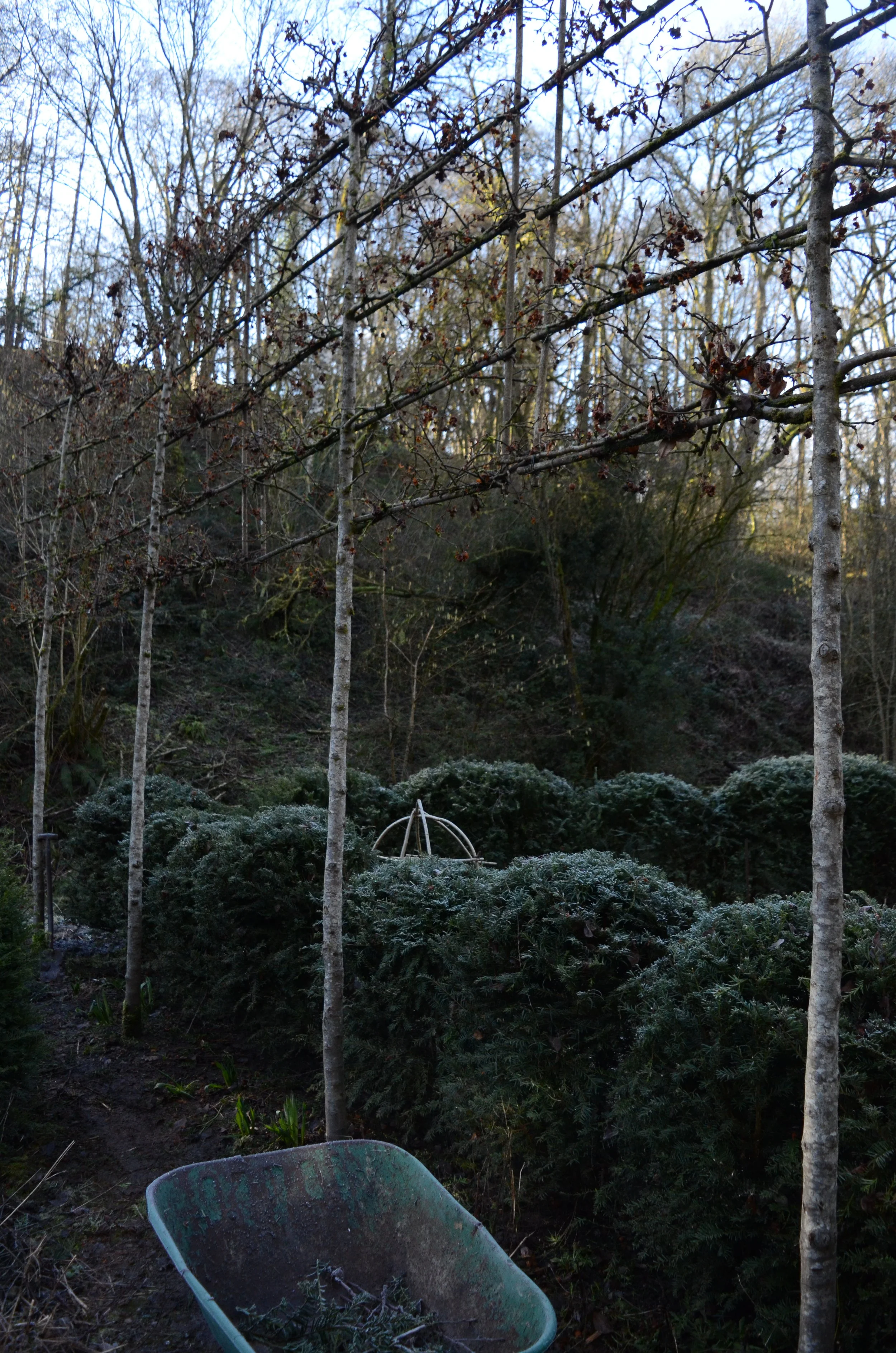
During Summer we have previously allowed the Taxus to ease into its stride; the fresh, soft growth mellows the gestures of the meticulous Winter silhouette that we form with weighted emphasis, mostly because it would be laborious to wade into the planted growth to take it back to strict outline, although this year, now the hedges have reached their desired figure, we will endeavour to undertake a May/June trim to retain its tightened form. It is a balance; during Summer highs, the topiary becomes less significant, its grandeur veiled by the downiness of perennials and grasses that saturate the ornamental spaces. Now, in February, the garden sits unclothed by this impression, honest, unforgiving in its bare splendor of nakedness, its architecture becoming prominent, isolated in attunement with the Hamamelis and ornate structure of pleached trees. We savour this moment as the garden feels calmer, simpler; its openness in tune with the expanse too found in the woodland, although it is all about this reciprocity, the garden existing amidst its surroundings, a co-existence, a dialogue that allows the garden to feel at one with its sense of place.